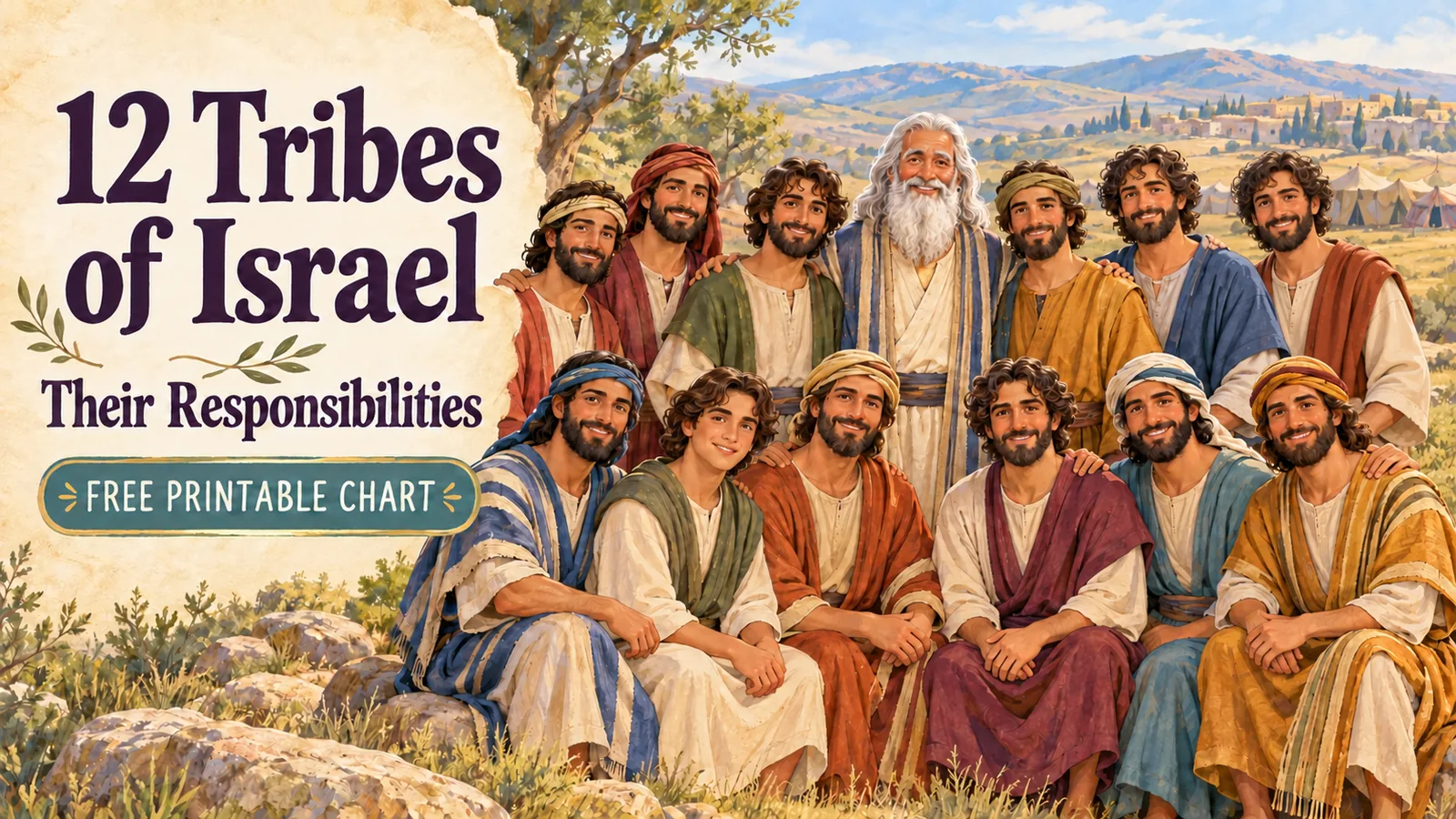
The twelve tribes of Israel were the family groups descended from Jacob, whom God named Israel. When we ask about the 12 tribes of Israel and their responsibilities, the Bible gives a mixture of assigned duties, blessings, land allotments and descriptions of particular people. It does not give each tribe a permanent occupation.
Levi has clearly described duties in worship and teaching. Other tribes are associated with leadership, land, food, ships or military strength in specific passages. Use the chart below to see what each passage actually says, then read it together as a family.
Download the free one-page 12 Tribes of Israel chart (PDF). It includes all twelve names, brief explanations and clickable Bible references.
12 Tribes of Israel and their responsibilities: Bible reference table
This table follows Jacob's twelve sons, including Levi and Joseph. The middle column separates assigned service from other biblical associations. These summaries are in our own words, with links to the passages on Bible Gateway.
| Tribe | Role or biblical association | Bible reference |
|---|---|---|
| Reuben | Firstborn status lost. Jacob called Reuben his firstborn but said he would not excel because of his wrongdoing. This is a judgment, not an assigned occupation. | Genesis 49:3-4 |
| Simeon | Land within Judah. Simeon received towns within Judah's territory. The passage explains that Judah's allotted portion was larger than it needed. | Joshua 19:1-9 |
| Levi | Worship service and teaching. Levites served at the tabernacle and assisted Aaron. Aaron and his sons held the priestly office. Moses' blessing also describes teaching Israel God's law. | Numbers 3:5-10; Deuteronomy 33:8-10 |
| Judah | Royal leadership. Jacob's blessing connects Judah with rule through the image of a scepter. David was from Judah. This does not mean every Judahite was a ruler. | Genesis 49:8-10; 1 Samuel 17:12 |
| Dan | Judging in Jacob's blessing. Jacob says Dan will judge his people. This blessing does not appoint every member of the tribe as a judge. | Genesis 49:16 |
| Naphtali | Blessing and poetic imagery. Jacob compares Naphtali to a doe; Moses speaks of the Lord's favor and blessing. Neither passage gives the whole tribe a fixed profession. | Genesis 49:21; Deuteronomy 33:23 |
| Gad | Warriors supporting David. A group of Gadites who joined David is described as skilled warriors. This describes those men, not a job assigned to every Gadite. | 1 Chronicles 12:8 |
| Asher | Rich food and oil. Jacob's blessing describes rich food and royal delicacies; Moses' blessing uses the image of dipping a foot in oil. These are blessings, not an exclusive farming duty. | Genesis 49:20; Deuteronomy 33:24 |
| Issachar | Discernment in David's time. Leaders of Issachar understood the times and knew what Israel should do when they supported David. The verse does not name astronomy or calendar keeping as their occupation. | 1 Chronicles 12:32 |
| Zebulun | Seas and journeys in the blessings. Jacob mentions a haven for ships. Moses speaks of going out and the abundance of the seas. These associations do not require every Zebulunite to be a sailor or trader. | Genesis 49:13; Deuteronomy 33:18-19 |
| Joseph | Ephraim and Manasseh. Jacob blessed Joseph's sons, Ephraim and Manasseh, as his own. In the land allotments, these two tribes represent Joseph's family. | Genesis 48:5; Joshua 14:3-4 |
| Benjamin | Warrior imagery. Jacob compares Benjamin to a wolf. The image describes strength and taking spoil; it is not a command that every Benjaminite must fight. | Genesis 49:27 |
Download the printable 12 Tribes of Israel chart
The free chart is a one-page A4 PDF for parents, teachers and children to use together. Its text stays sharp when printed, and the compressed file is small to download. It is a learning reference chart, rather than a coloring sheet or a PDF copy of this whole article.
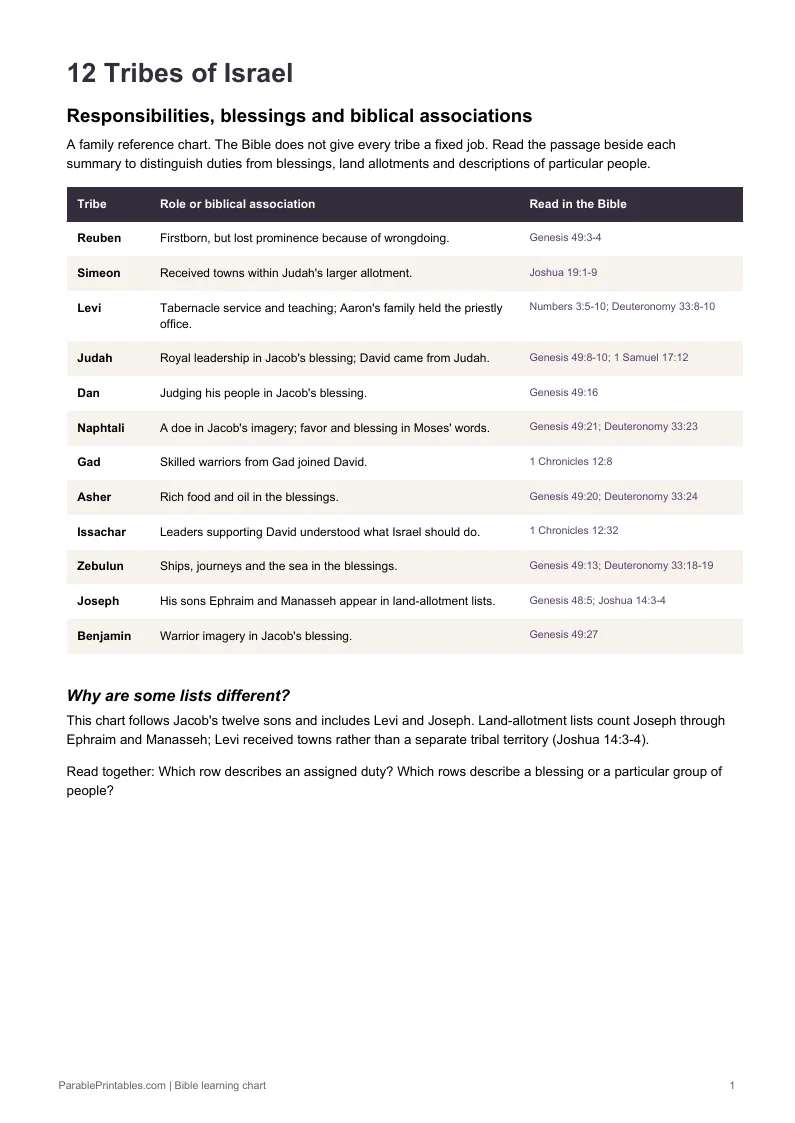
Download or open the chart PDF. Select A4 portrait when printing. For US Letter, choose Fit to page and check the preview.
Who were the twelve tribes of Israel?
Jacob was the son of Isaac and the grandson of Abraham. God gave Jacob the name Israel. His twelve sons were Reuben, Simeon, Levi, Judah, Dan, Naphtali, Gad, Asher, Issachar, Zebulun, Joseph and Benjamin. Their descendants became the tribal families of Israel. Read Genesis 35:9-12; Genesis 35:22-26.
A tribe was a large family group made up of many households. Children can picture a family tree: Jacob is one generation, his sons are the next, and the branches grow as their families grow.
Why do some lists include Ephraim and Manasseh?
Joseph had two sons, Ephraim and Manasseh. Jacob received them as his own sons for the inheritance blessing in Genesis 48:5. When the land was divided, Joseph's family was counted through these two tribes.
Levi received towns and their surrounding pasturelands instead of a separate territorial allotment like the other tribes. That is why a list of Jacob's sons includes Levi and Joseph, while a land-allotment list may show Ephraim and Manasseh and treat Levi separately. Read Joshua 14:3-4; Joshua 21:1-3.
The lists have different purposes. Do not add every name from every list together and assume the Bible is describing one list of fourteen equivalent territories.
Did every tribe have a special job?
No. Some popular charts turn a blessing or a memorable description into a job title for an entire tribe. The passages need more care than that.
- Assigned service: the Levites were given responsibilities at the tabernacle. Aaron and his sons held the priestly office. Being a Levite did not automatically mean being an Aaronic priest. See Numbers 3:5-10.
- Blessings: Jacob's words about ships, rich food and a scepter describe the tribes in poetic language. They do not say every member must follow one occupation. Read Genesis 49.
- Specific people: the men of Issachar who understood the times were part of the support gathered around David. The passage does not call the whole tribe professional astronomers or calendar keepers. See 1 Chronicles 12:23-32.
For younger children, explain it this way: the Bible tells us different things about these families, but a description is not always an instruction.
The story behind the tribes: a family overview
Joseph and the journey to Egypt
Jacob's family experienced jealousy and serious wrongdoing. Joseph's brothers sold him, and he was taken to Egypt. Later, during a famine, Joseph was in a position to provide food. His brothers came to Egypt, and Joseph eventually made himself known to them. Jacob and the wider family then settled there. Read Genesis 37; Genesis 45-46.
Moses and the journey out of Egypt
In later generations, the Israelites were enslaved in Egypt. God sent Moses to lead them out. At Sinai, God gave Israel his covenant commands. The tribes traveled as a people with distinct family groups, and the tabernacle stood at the center of their camp. Read Exodus 1-3; Exodus 19-20; Numbers 2.
For another family reading, see Moses and the Ten Commandments.
The land and later kings
Under Joshua, the tribes received their land allotments. The books of Judges and Samuel describe later challenges and leaders. Saul was from Benjamin, and David was from Judah. After Solomon's reign, the kingdom divided. These later events are another reason to read each tribal description in its own setting. See Joshua 13-21; 1 Samuel 9:1-2; 1 Samuel 17:12; 1 Kings 12.
A simple learning activity for families
- Find the names. Read the names on the chart aloud. Ask your child to find Joseph and Levi.
- Follow one reference. Open the passage about Levi or Simeon. Which part of the chart can you find in the passage?
- Sort the descriptions. Choose one duty, one blessing and one description of a particular group of people.
- Draw a family tree. Put Jacob above his twelve sons. Draw Ephraim and Manasseh beneath Joseph to show why those names also appear.
Younger children can focus on recognizing names. Older children can compare the sources and explain why the word responsibilities needs care.
Frequently asked questions
Which tribe served as priests?
Aaron and his sons, who belonged to Levi, were appointed to the priestly office. Other Levites assisted in the service of the tabernacle. Numbers 3:5-10 makes this distinction.
Was Judah responsible for ruling Israel?
Judah is associated with royal leadership in Jacob's blessing, and David came from Judah. This is not an instruction that every person in the tribe should rule. See Genesis 49:8-10; 1 Samuel 17:12.
Were the tribes named after their responsibilities?
The tribal names come from Jacob's sons. The birth accounts explain the names through family circumstances and wordplay, rather than a list of occupations. Read Genesis 29:31-35; Genesis 30:1-24; Genesis 35:16-18. Those name explanations are a different subject from later roles or blessings.
Why did Simeon receive land inside Judah?
The land-allotment account explains that Judah's portion was too large for it, so Simeon received an inheritance within it. See Joshua 19:1-9.
Is there a free PDF of the twelve tribes and their responsibilities?
Yes. Download our one-page printable chart for a concise summary with Bible references. It identifies biblical associations without inventing a fixed profession for each tribe.