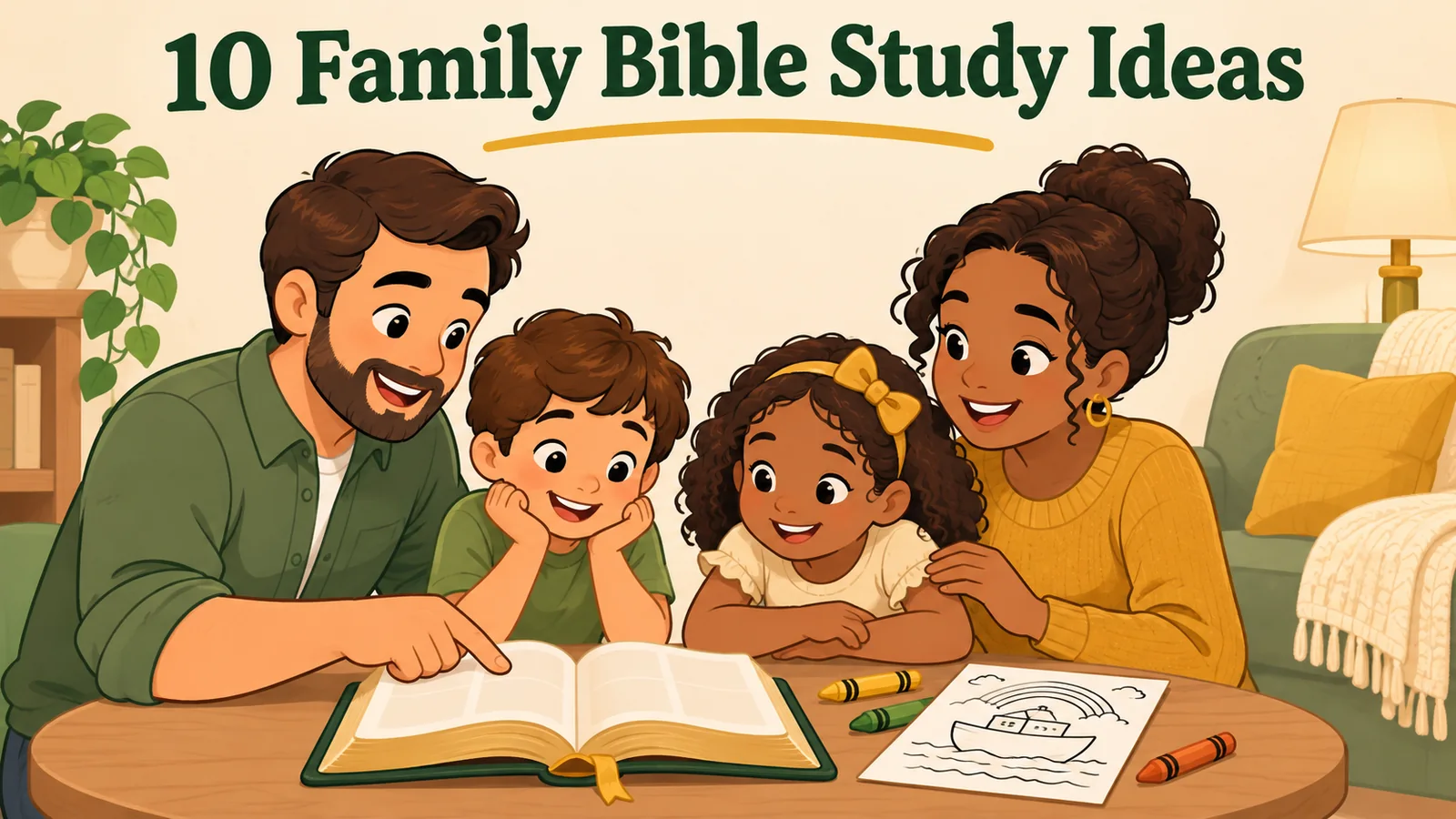
Family Bible study can be a short shared activity: read a passage, try one simple idea and talk about what you noticed. These ten family Bible study ideas use coloring pages, printable tools and everyday supplies. Choose one that suits the children with you; you do not need to complete the whole list.
1. Read a short passage and color one picture
Choose a scene before you begin, then read its Bible passage aloud. Let children color while you read, or read first and color afterward. Ask them to point to something in the picture that is mentioned in the passage.
Try Jesus Calms the Storm coloring pages with Mark 4:35-41 (WEB). An adult can read while a younger child chooses colors.
2. Put three story pictures in order
Print three scenes from a collection and mix them up on the table. Read the matching passage, then arrange the pictures in the order the events appear. Invite each child to describe one picture. Return to the passage when you are unsure about a detail.
Use the Jonah and the Big Fish collection for this activity. Older children can find the verse linked beneath each design; younger children can place the pictures.
3. Make a family Bible coloring book
Let each person choose a few pictures from the Bible Coloring Book Builder. Combine them into a printable book, then work through one page at a time. Keep the book together with a clip or folder so the family can return to it.
For a mixed-age group, offer a simple picture to younger children and invite older children to find and read its passage. Everyone can take part in the same topic without doing the same task.
4. Make one Bible memory card
Choose a short verse or a short passage with the Bible Memory Card & Bookmark Maker. Read it together before printing, then keep the card where your family will see it. Take turns reading a few words and allowing someone else to continue.
Use the translation and reference shown on the card. If you choose only part of a verse, keep the wording unchanged and read the surrounding passage together.
5. Trace a verse, then read it aloud
Open the Bible Verse Tracing Worksheet Maker and choose text that fits the child's reading and writing stage. A short selection may be enough. Read it aloud, trace it slowly and let the child decorate the page afterward.
A child who is not ready to trace can point to familiar letters or listen while an adult reads. Keep the activity optional and allow breaks.
6. Use a word search as a passage finder
Make a puzzle with the Bible Word Search Maker. Read the Bible account connected to the puzzle's theme. After finding a word, look for that word or the person or object it names in the passage.
Help younger children search for the first letter; let confident readers work independently. The answer key can help an adult check the puzzle without interrupting everyone else.
7. Explore a Bible alphabet letter
Choose one of the ABC Bible Coloring Pages. Say the letter, read the word and open its linked passage. Children can color the large letter and picture, then look for the same letter on the page or in a printed Bible.
Use the alphabet sheet as a reading activity rather than a substitute for the Bible account. The X sheet asks children to find X inside the word exalt.
8. Act out a short scene after reading
Choose a simple scene with a few speaking parts. Read it first, then decide who will read the Bible text and who will show the actions. A scarf, chair or empty basket is enough; elaborate costumes are unnecessary.
Try a gentle part of Luke 10:25-37 (WEB), such as the Samaritan helping the traveler. Children can use the Good Samaritan coloring pages afterward. Keep any actions safe and leave out physical reenactments of harm.
9. Let children lead with three questions
After reading, take turns answering: Who is in this passage? What happened? Which words would you like to ask about? Give children time to answer in their own words, and show where an answer appears in the text.
It is fine to say that you do not know. Write down a question to explore later instead of adding a detail that the passage does not give. A younger child can respond by pointing to a picture.
10. Finish with a short prayer and a practical response
Invite anyone who wants to pray to use a short sentence. Children may listen without speaking. Then agree on one simple family action, such as sharing supplies, helping tidy the table or making a card for someone.
The Lord's Prayer coloring pages provide the WEB text of Matthew 6:9-13 if you would like to read a prayer together.
A simple way to start this week
Pick one passage and one activity. Gather the Bible, a printable page and some crayons. Allow around ten minutes to start, then adjust to your family's attention and energy. Repeating a familiar activity is fine; the aim is shared reading and conversation, not finishing a worksheet.
For more choices, browse Bible coloring pages or the printable-making tools.